Corpus Analysis
Corpus Analysis summarizes many trials at once. It uses the same dataset and trial filters as the Scanpath view. The line beside the dataset picker counts what those filters keep (for example 12 of 24 trials · 1 of 2 participants) and names each active filter. Edit filters opens the Scanpath view's filter panel, and Clear resets every filter.
Reading measures come from your data
Corpus Analysis shows the reading measures your interest-area report provides
(first fixation duration, total fixation duration, regression path, and so on).
It does not compute them itself. An EyeLink report's IA_* columns are mapped
automatically; other names can be mapped under Data Management → Edit dataset.
Without any, the page says so. The per-fixation measures are the fixation table's
own durations, and its saccade amplitudes, or, when it has none, the distance
between consecutive fixations.
Three views
| View | Answers |
|---|---|
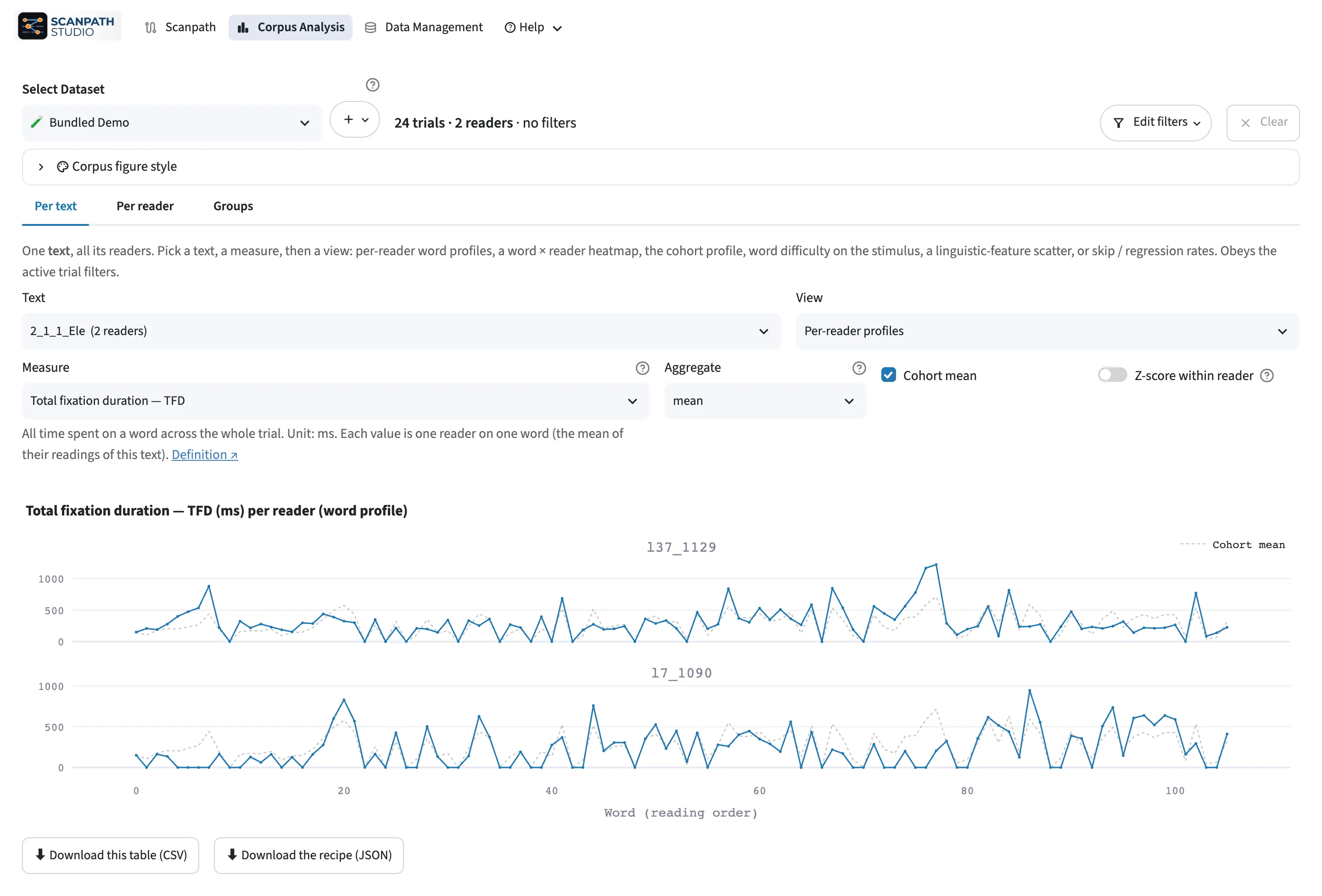
| Per text | How was this text read, word by word, across participants? |
| Per participant | How does this participant behave across trials? |
| Groups | How do conditions or populations differ? |
The address bar names the open view (?corpus_subtab=Per+participant), so a
bookmark or a copied link reopens it.
Choose a measure, how to aggregate it, and the spread to show. A line under the measure says what it is, its unit, and what each plotted value is (one word, one participant's mean, …), with a link to its definition; a line under the spread says whether it shows how values vary (SD, IQR) or how precisely the center is known (SEM, bootstrap CI). Set a minimum number of participants per word so sparse words don't look like stable estimates.
Groups defines a cohort by splitting on a field, or with its own filters. Turn on Compare a second group, with the two group means and their difference — descriptive, with no significance test. Fields from attached participant, trial or text tables appear here too.
From summary to evidence
Every result table has ⬇ Download this table (CSV), with ⬇ Download the recipe (JSON) beside it: the dataset, trial filters, analysis choices and counts that produced the table, without its rows or any figure settings. When something looks odd, open the trials behind it in the Scanpath view.